
Home-Cooked Meal Delivery Menu: What Is on Each Day and How It Changes
What is on a home-cooked meal delivery menu each day? How the morning market sets three dishes, how they change, and real photos of what we cook.
 EdwinPublished 2 Oct 2026Updated 6 Oct 202611 min read

Most people looking at a home-cooked meal delivery menu want a plain answer to a plain question: what will we actually eat on Monday, and will Thursday be any different? At our kitchen the honest answer comes in two parts. There is no printed menu for the week ahead, because the dishes are chosen each morning after the market. Yet the shape of every meal is fixed, the range of regular dishes is published, and real photos of food the kitchen has cooked are easy to show.
This guide walks through what goes into one day's menu, how the dishes move through a Monday-to-Friday week, and what the kitchen has really put in its trays, grouped by type so you can judge the cooking with your own eyes. Prices, portions and handover each have their own guide, linked where they come up.
Aunty Home Cooking
Order home cooked meals in Puchong
3 home cooked dishes every meal, from RM15 per pax, Monday to Friday. Free delivery in Puchong and Bandar Sunway.
Also delivering to Bandar Sunway
1. What the daily menu means in a market-led kitchen
Every weekday begins with the shopping. The cook goes to the morning market, sees what is fresh, and settles the day's dishes from there. The food is cooked on the day it is delivered, never the day before. So the daily menu is not a document you read in advance; it is decided that morning and reaches you as that day's lunch or dinner.
What does not move is the structure. Each lunch or dinner is three home-cooked dishes, and the kitchen keeps to the same pattern every day:
- One meat or fish dish: chicken, pork or fish, depending on the morning
- One vegetable dish
- One egg or tofu dish
- Soup on some days, not every day
- Plain rice only if you add it, since it is not one of the three dishes
That pattern is the real answer to "what is on the menu today?" You can count on a protein, a vegetable and an egg or tofu dish. Which ones you get is only known once the shopping is done, so a Monday question about Wednesday's dishes will usually get a friendly "we decide that on Wednesday morning".
Your side of the order is therefore about days and sessions, not dishes. You pick which weekdays need lunch, dinner or both, and the kitchen fills each session. Requests you have agreed beforehand, such as no pork or less chilli, travel with the order and shape whatever is cooked that day.
2. How the dishes change through the week
Lunch and dinner on the same day are two different meals, sent as separate deliveries, each with its own three dishes. Across a week, every day brings a fresh combination, and across a month the menu does not repeat. Behind that sits a rotation of about 100 regular dishes spread over chicken, pork and fish, which is wide enough that a household ordering every weekday still meets new food.
For example, imagine a dinner-only week
Picture a household that takes dinner from Monday to Friday. One evening might lead with a chicken dish, the next with fish, another with pork, and each would sit beside a different vegetable and a different egg or tofu dish. Soup might turn up on one or two of the five evenings. None of it would be announced ahead, and the week after would bring another set of combinations. This sketch shows the pattern only; it is not a record of any real week.
Sorting the steady parts from the moving parts makes the arrangement easier to picture:
- Steady: three home-cooked dishes in every session, with rice as a separate add-on
- Steady: lunch and dinner arrive separately and never share the same dishes
- Steady: lighter home-style cooking with less oil and less salt
- Steady: the food requests you settled with the kitchen before ordering
- Moving: which meat or fish, which vegetable and which egg or tofu dish you receive
- Moving: whether soup comes with the meal, since it is offered on some days only
Ordering for more people does not widen the menu. Two or three diners receive bigger portions of the same three dishes, so variety comes from the number of days and sessions you take, not from the headcount.
3. Examples of dishes the kitchen regularly cooks
Names from our regular-dish list include ginger and spring onion chicken (姜葱鸡), sesame oil chicken (麻油鸡), three-cup chicken (三杯鸡), lemon chicken (柠檬鸡), sweet-and-sour pork (咕噜肉), braised pork with preserved mustard greens (梅菜扣肉), steamed pork patty with salted egg (咸蛋蒸肉饼), ginger-steamed fish (姜丝蒸鱼), assam fish (亚参鱼) and tomato-braised fish (番茄焖鱼). These are examples of dishes we regularly cook, not a five-day log, a set meal or a promise that a dish will appear on a certain date.
The full list of regular dishes is grouped into chicken, pork and fish, and it is the best single view of the kitchen's range. Notice the spread of methods as much as the ingredients: steamed, braised, curried, pan-fried and cooked with sambal all appear. The list names the main protein dishes; the vegetable and the egg or tofu dish complete each meal around them.
A few habits make the list more useful:
- Read it as a picture of the kitchen's range, not as a list to order from.
- Look for cooking styles your household enjoys, such as steamed fish or braised pork.
- If a listed dish contains something you avoid, name the ingredient, so the request covers every day.
- Do not expect a dish on a fixed weekday just because it is on the list.
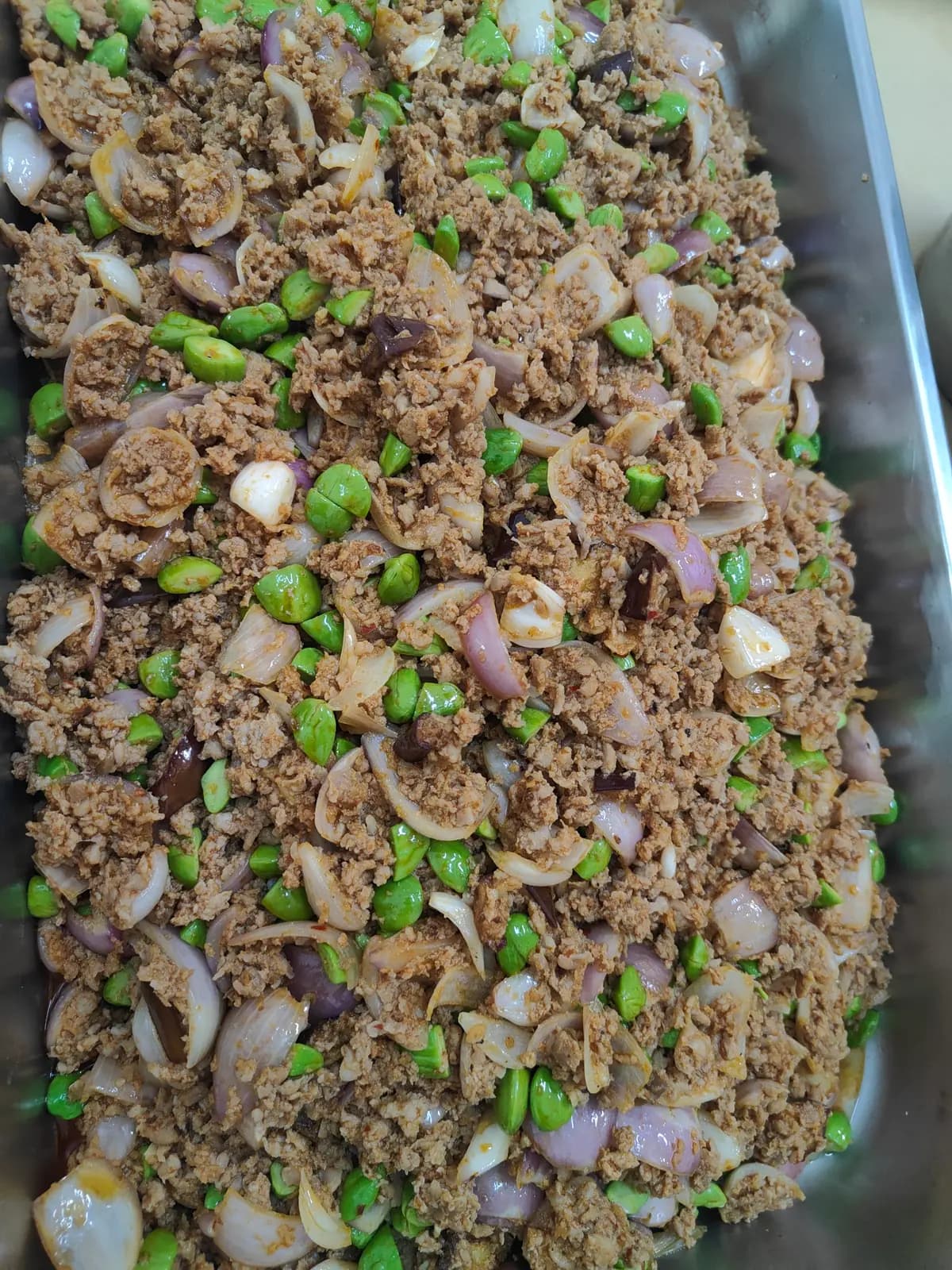
The two photos below come from the vegetable side of the menu: a tray of cooked pieces with green beans and onion, and green vegetables finished with a browned topping.

4. Dish wall: fried bites finished three ways
A list of names only goes so far, so this section and the next form a small dish wall: photos of trays the kitchen has actually cooked, grouped by type. They were taken while cooking for a group order, which is why the trays are large; a household meal comes in your own containers in a household quantity. Please treat every photo as an example of the cooking, not a dated menu or a preview of your next delivery.
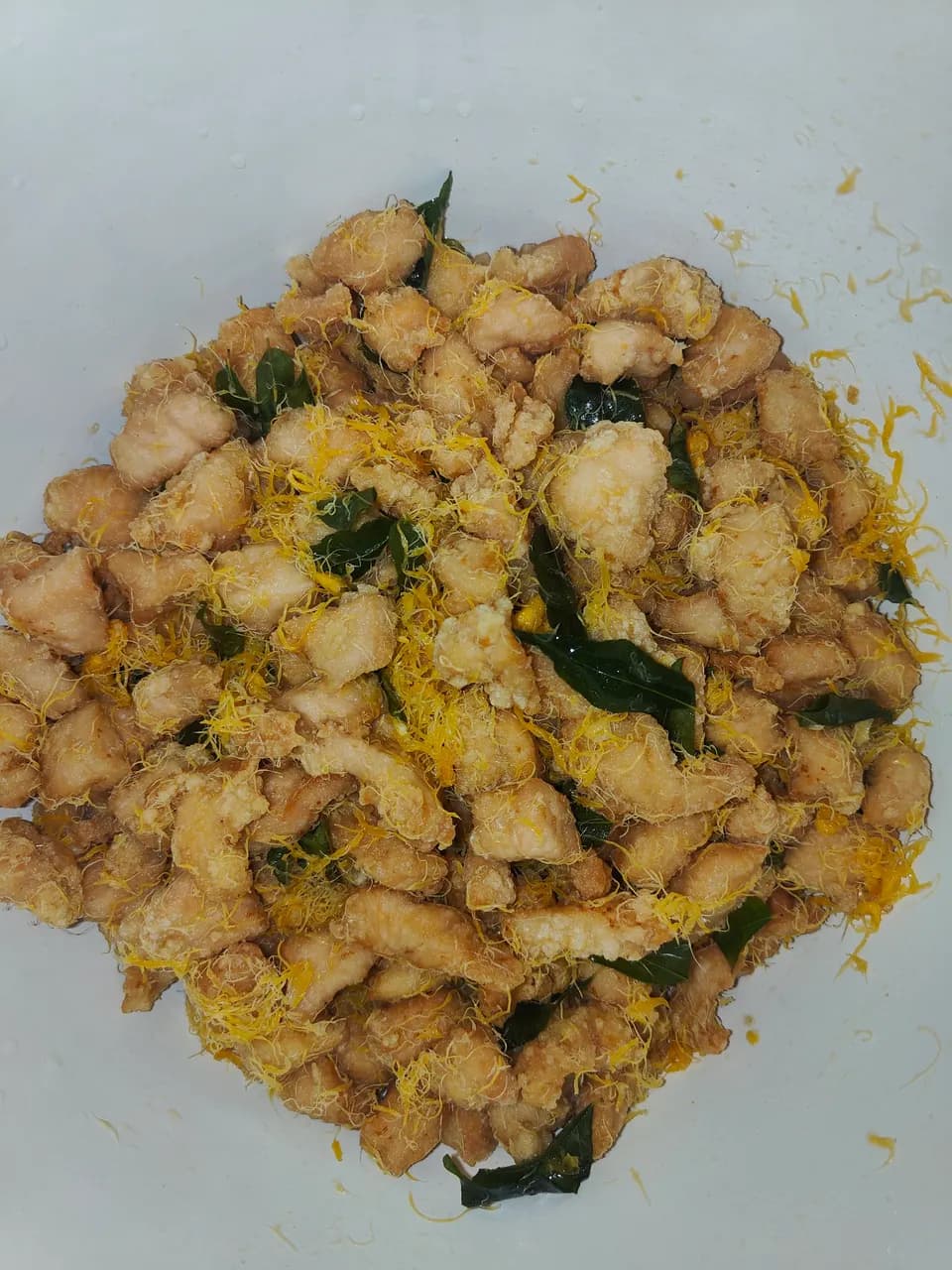
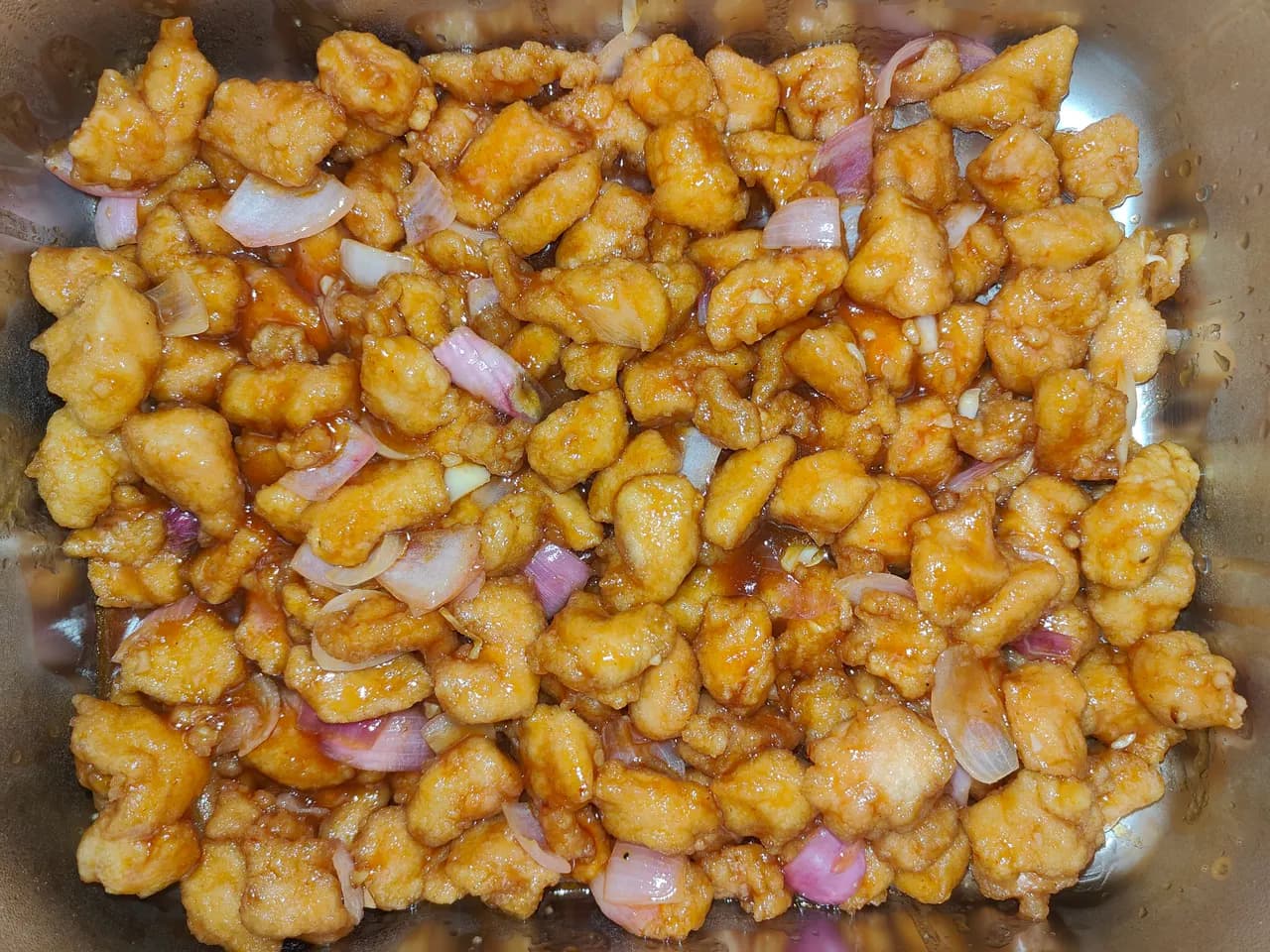
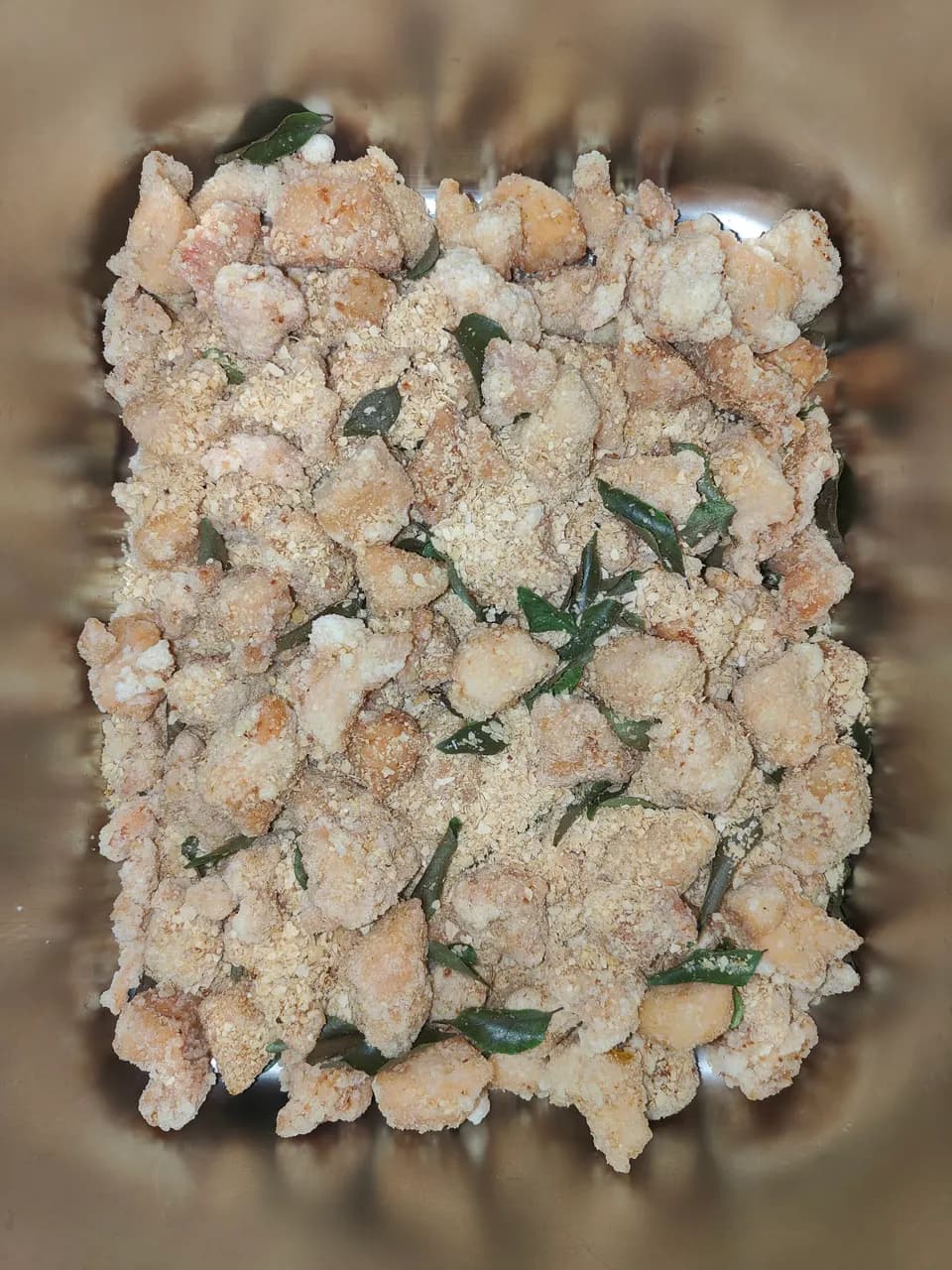
The first group shows how one kind of dish can look quite different from tray to tray. Each starts as bite-sized pieces fried until golden, and then the finish changes:
- Tossed dry with curry leaves and a scattering of fine golden shreds
- Coated in a glossy orange sauce with chunks of red onion
- Rolled in a light golden crumb with curry leaves
This is how a market-led kitchen keeps meals varied without a fixed recipe card for each weekday. The sauce, the coating and the aromatics change as well as the main ingredient, so two meals built on similar pieces still eat differently. Here is how those three finishes looked in the tray.
5. More from the dish wall: sliced chicken and fish cake
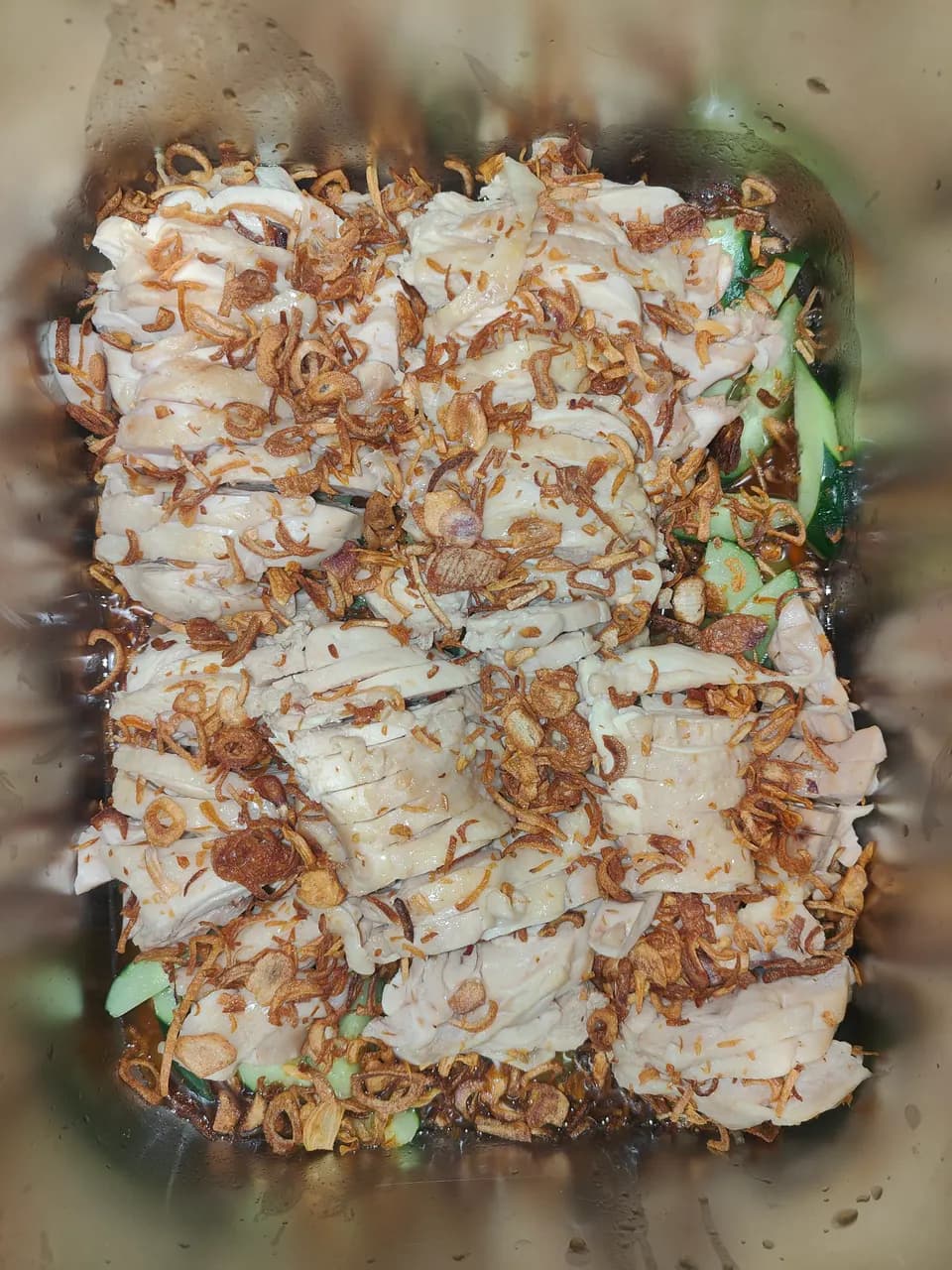
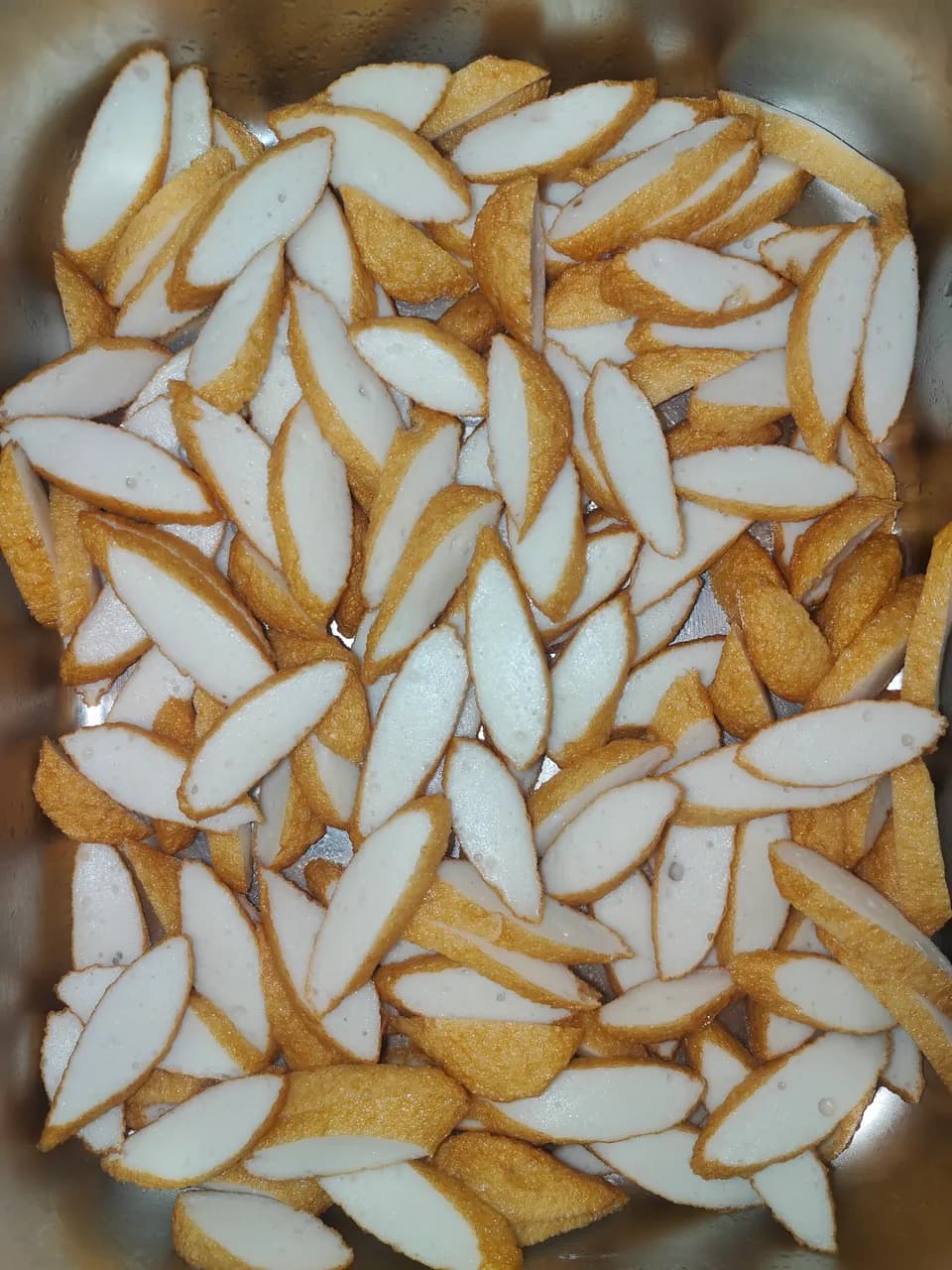
The second group moves away from fried pieces. One tray holds sliced chicken laid in neat rows and topped with crisp fried shallots, with cucumber showing underneath. Another holds fish cake cut into thin, slanted slices, golden at the edges and white inside. Neither appears on the regular-dish list by name, which is a useful reminder: the list shows the main rotation, while real meals also include simpler items like these around it.
The wall has gaps, and it is better to say so. This batch of photos has no egg or tofu tray, although an egg or tofu dish is part of the usual pattern, and the vegetable examples sit under section 3. The point of the wall is not to cover every category but to show real food from this kitchen rather than styled pictures.
When you study food photos from any kitchen, ours included, these are the details worth looking at:
- Whether the food was cooked in that kitchen, not borrowed from a stock library
- How evenly the pieces are cut and cooked
- How much sauce there is, and whether it will travel well in a container
- Whether the style suits everyone at your table, including children and older relatives
- Whether vegetables and lighter dishes appear, not only the most photogenic meat
Below are the sliced chicken and fish cake trays.
6. Fixed menus, pick-your-own lists and a market-led rotation
Look around at home meal services and menus tend to come in three shapes. Some publish a set menu for the week or the month, often repeating on a cycle. Some offer a long list of dishes and ask you to choose your own. A market-led kitchen does neither: it publishes its range, shows real photos, and decides each day's dishes after shopping.
Each shape has trade-offs. A set menu lets you plan around dishes you dislike, but recipes come round on a timetable and the shopping follows the plan rather than the market. A pick-your-own list gives control, but you do the choosing every week, and the dishes you pick are not necessarily the freshest that day. A market-led rotation brings variety without any homework from you; the price of that is no preview, which is why requests need to be phrased as ingredients rather than dish names. If you have tried prepared meal delivery from a set weekly menu before, this is the main difference to get used to.
Questions that reveal how a menu really works
- Is the menu fixed in advance, chosen by the customer, or decided on the day?
- How often can the same dish come back?
- Do lunch and dinner use different dishes?
- Are the photos of food that this kitchen cooked?
- On a day that features pork, what happens to a no-pork household?
- How many dishes make up a meal, and does that count include rice?
Our answers, briefly: decided each morning; no repeats within a month; always different at lunch and dinner; real photos only; a no-pork order gets chicken or fish instead; three dishes, with rice as an add-on. For a broader checklist that also covers prices and practical terms, see what to confirm before ordering home-cooked food in Puchong.
7. Requests and sessions when the menu changes daily
With no dish fixed ahead, a request has to hold up whatever the market offers. That is why the kitchen asks for ingredients or tastes rather than dish names. "No pork" can be planned around every single morning; "we don't like sweet-and-sour pork" covers one dish out of a hundred. "Less chilli for everyone" works on any day; "no curry on Tuesdays" does not fit a menu that is not tied to weekdays. The full picture of which adjustments work, and the limits on allergens, vegetarian food and halal certification, is in our guide to home-style meal requests.
An allergy deserves its own conversation before you order. Because each day's dishes are new, the kitchen tries to keep a named allergen out every morning, but it cannot guarantee that any meal is free of it.
Once the requests are clear, the remaining choice is sessions and days. Lunch, dinner or both can be taken on any weekday, with no minimum and no contract, and published prices start from RM15 per meal for one person on the home meal package page. Delivery is free in Puchong and Bandar Sunway. If you are fitting two deliveries around school runs and work, planning weekday family meals in Puchong lays out the week session by session.
8. Common misunderstandings about a changing menu
Most confusion comes from expecting a changing menu to behave like a restaurant menu or a set meal plan. A few clarifications save some back-and-forth:
- "Different dishes every day" does not mean you pick from options each day; the kitchen chooses.
- Photos on the site and in this post show past cooking, not your next delivery.
- Soup is not part of every meal; it is offered on some days.
- The dish list is a range, not a rota, and no dish belongs to a particular weekday.
- A larger headcount means bigger portions, not extra dishes.
- A confirmed request such as no pork carries over to every day you order.
- "No repeats within a month" does not mean a dish never returns; the rotation comes round again later.
If anything is still unclear, ask before the first delivery. Settling a request at the start is much easier than changing it partway through a week.
Ask what the kitchen is cooking
WhatsApp +60 10-865 5536 with your Puchong or Bandar Sunway address, the days and sessions you need, your headcount, rice count and any food requests. You are welcome to ask for recent photos of the kitchen's cooking before you decide. Aunty Home Cooking is the home kitchen in Puchong behind this changing menu.
FAQ
No. The dishes are decided each morning after the market, so there is no menu for the week ahead. You can browse the regular-dish list and real photos to judge the range.
Three home-cooked dishes per session: a meat or fish dish, a vegetable dish, and an egg or tofu dish, with soup on some days. Rice is an optional add-on.
Yes. The kitchen is in Puchong and delivers free across Puchong and Bandar Sunway, Monday to Friday. Other areas are on request.
No. They are different dishes, delivered separately, each with three dishes.
No. The kitchen does not follow a weekly cycle, and the menu does not repeat within one month.
No. They show trays the kitchen has cooked, as examples of its cooking. They do not predict what a particular day will bring.
Yes, if you ask in advance. On days the kitchen cooks pork, your meal comes with chicken or fish instead.
Share this article
Related Articles
Healthy Home-Cooked Meal Delivery in Sunway: What Lighter Home Cooking Really Means
Healthy home-cooked meal delivery in Bandar Sunway, honestly explained: less oil, less salt, real vegetable dishes, food requests and clear limits.
 Edwin25 Sept 202610 min read

Meal Delivery for One, Two or Three People: Choosing Your Size in Puchong and Bandar Sunway
Meal delivery for one, two or three people in Puchong and Bandar Sunway: the same three dishes packed for each size on one day, prices and rice per person.
Edwin9 Oct 202611 min read
About the author
Edwin
Edwin writes practical guides about Aunty Home Cooking's meals, ordering and delivery.
This guide uses the kitchen's published service details and owner-supplied photographs of past meals. Confirm current order details with the kitchen before paying.